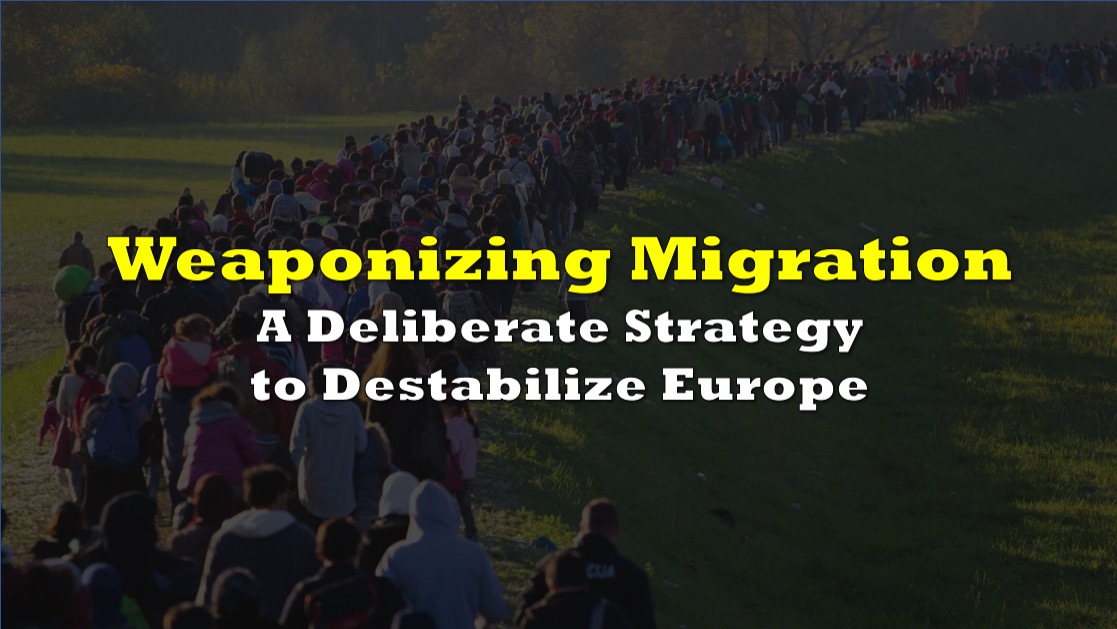

Recent scholarly work and emerging reports suggest that the weaponization of migration has become a deliberate tactic used by state actors to destabilize neighboring regions. This concept, discussed in international law expert Aaron Petty’s analysis “Migrants as a Weapons System,” posits that migration is being manipulated as a geopolitical tool to exert pressure and create chaos in targeted countries.
Petty’s paper highlights the intentional targeting of civilians to create refugees, with the aim of destabilizing European neighbors. “It takes a particularly evil mindset to see that people and their vulnerability and humanity can actually be used as a means to achieve political ends,” Petty quotes Ivo Daalder, former U.S. Ambassador to NATO. This perspective aligns with the actions of Russian President Vladimir Putin, as he reportedly targeted civilians in Ukraine to generate a refugee crisis.
“The displacement of civilians would have been of secondary importance to occupying Ukrainian territory, but an important Russian objective nonetheless,” writes Petty. By displacing Ukrainians, Russia not only weakened Ukraine but also pressured neighboring European states dealing with the influx of refugees.
 Sponsored · PTX Metals Inc.
Petty also notes the strategic advantages Russia gains through such actions. “Even as a second-order effect, it would have illustrated to neighboring states what could happen to them if they resist Russian suzerainty, while concurrently fomenting domestic dissension simply by the presence of large numbers of displaced people,” he explains. This tactic is part of a broader strategy to maintain regional influence and deter opposition.
Petty also cites the situation in Belarus as a stark example of this strategy. In late 2021, U.S. officials accused Belarusian leader Alexander Lukashenko of using migrants to create a humanitarian crisis. Testimonies gathered by Amnesty International depict harrowing abuses suffered by migrants at the hands of Belarusian forces. Migrants, including families with children, faced beatings, extortion, and brutal conditions as they were pushed back and forth across the Belarus-EU border.
Jennifer Foster, a Refugees and Migrant Rights Researcher at Amnesty International, described the dire conditions: “People at the border find themselves between a rock and a hard place. Stranded in what is effectively an exclusion zone on Belarus’s border with the EU, they face hunger, exposure, and shocking levels of brutality from Belarusian forces repeatedly forcing them into Poland where they are systematically pushed back by Polish officers.”
One Syrian man recounted the brutality: “There were about ten [Belarusian] soldiers and they had four dogs with them. They said they would let the dogs loose so if we didn’t run fast, we would get bitten. The soldiers ran after us beating anyone who didn’t run fast enough with batons.”
Despite the evident violations of human rights and international law, the European Commission has struggled to implement effective legal proceedings against the abuses by EU member states bordering Belarus. Moreover, the proposed provisional emergency measures allowing Poland, Latvia, and Lithuania to derogate from EU rules have raised concerns among human rights organizations.
“Thousands of people – including many fleeing war and conflict – find themselves stuck in Belarus in the depths of winter in extremely precarious conditions,” Foster noted. “Instead of receiving the care they need, they are subjected to brutal violence. Belarus must immediately cease this violence, and EU member states must stop denying people the chance to escape these egregious violations let alone returning them to Belarus to face them again and again.”
Petty’s analysis underscores the complexity of responding to such tactics. “The attempt to coerce European countries through the instrumentalization of displaced Ukrainians should not have surprised anyone,” he asserts, indicating a need for better-prepared and more coordinated international responses.
Information for this briefing was found via Amnesty International and the sources mentioned. The author has no securities or affiliations related to this organization. Not a recommendation to buy or sell. Always do additional research and consult a professional before purchasing a security. The author holds no licenses.