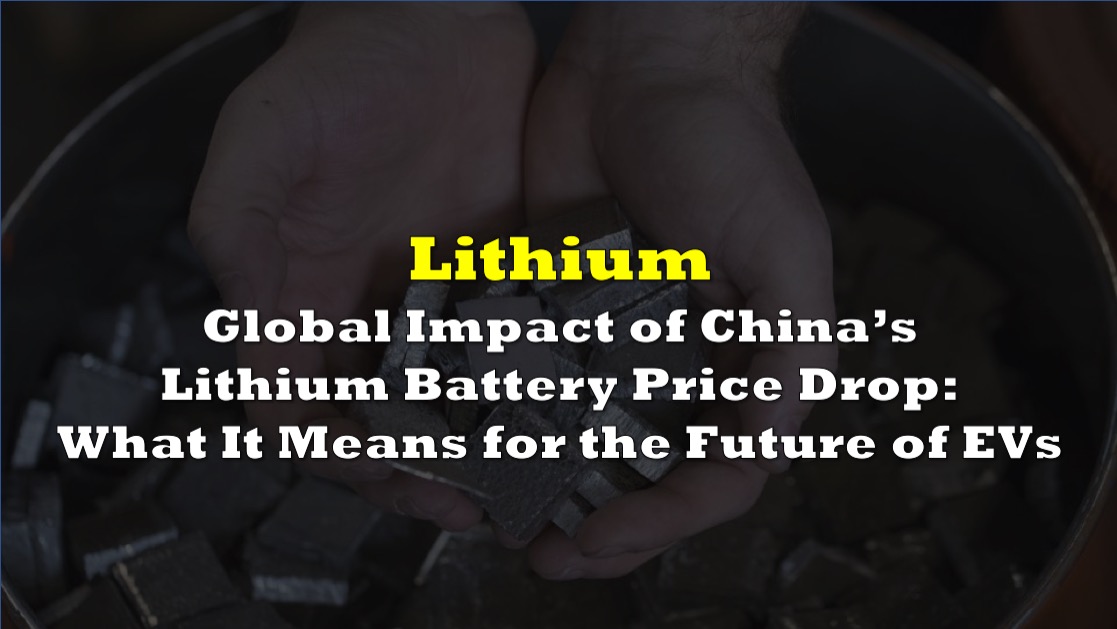

Prices for lithium-ion batteries in China are plummeting, marking a significant turning point for the global automotive and power sectors. Over the last year, the price for lithium iron phosphate (LFP) battery cells has dropped 51% to an average of $53 per kilowatt-hour (kWh), compared to a global average of $95/kWh last year. This dramatic price decline is poised to drive substantial changes in the markets for electric vehicles (EVs) and energy storage.
Several factors are contributing to this sharp price reduction. First, the cost of raw materials, particularly those used in the cathodes of batteries, has fallen significantly. The cathode share of the total cost for an LFP cell in China has decreased from 50% at the beginning of 2023 to less than 30% in mid-2024.
Secondly, overcapacity in the battery production sector is leading manufacturers to cut prices to maintain market share. Despite already high production levels, China’s battery production capacity continues to exceed global EV demand. Average capacity utilization of battery plants in China fell from 51% in 2022 to 43% in 2023, with further declines expected this year.
Technological advancements and improved manufacturing processes are also playing a significant role in driving down costs. Companies like CATL and BYD, leading figures in China’s battery industry, continue to invest heavily in research and development, automation, and new product launches. According to Colin Mckerracher, Head of Advanced Transport at BloombergNEF, these companies are “launching new products at a frenetic pace,” which helps keep prices low.
 Sponsored · Nord Precious Metals
The implications of these lower prices can be profound. Battery cells priced at $50/kWh mean that the technology required to decarbonize most road transport is already available. This price level is significantly below the $100/kWh benchmark, often cited as a critical threshold for making EVs cost-competitive with internal combustion engine (ICE) vehicles.
In China, battery-electric vehicles (BEVs) are now the cheapest drivetrain by average transaction price, even excluding mini city cars from the dataset. Almost two-thirds of EVs available in China are already cheaper than their ICE counterparts, and many more affordable electric models are expected to launch globally in the next few years.
The stationary energy-storage market stands to benefit significantly from these price reductions. The economics of adding large-scale energy storage are becoming increasingly attractive as battery prices fall. According to Mckerracher, global stationary storage installations are projected to reach 155 GWh this year, up 61% from the previous year.
Despite the positive outlook, the market is not without challenges. Overcapacity remains a significant issue, and it is unclear how long manufacturers can sustain the current price levels. The intense price competition may lead to a shakeout, where only the most efficient producers survive.
“All of this underscores how the harbingers of scarcity were wrong, at least so far. Over the last four years, there was a steady drumbeat of predictions that batteries and battery metals would be in short supply indefinitely,” Mckerracher said.
Toyota, one of the companies previously skeptical about the feasibility of fully electric vehicles due to battery supply concerns, now faces a different reality. The company had argued that sharing batteries between hybrids was a more efficient way to reduce emissions. However, the plummeting battery prices are challenging this view, highlighting the rapid pace of change in the industry.
Lamborghini, known for its high-performance combustion-engine vehicles, is also adapting to these changes. CEO Stephan Winkelmann recently discussed the company’s plans to continue offering plug-in hybrid supercars, aiming to navigate the European Union’s planned 2035 phase-out of new combustion-engine vehicles.
Information for this briefing was found via Bloomberg and the sources mentioned. The author has no securities or affiliations related to this organization. Not a recommendation to buy or sell. Always do additional research and consult a professional before purchasing a security. The author holds no licenses.